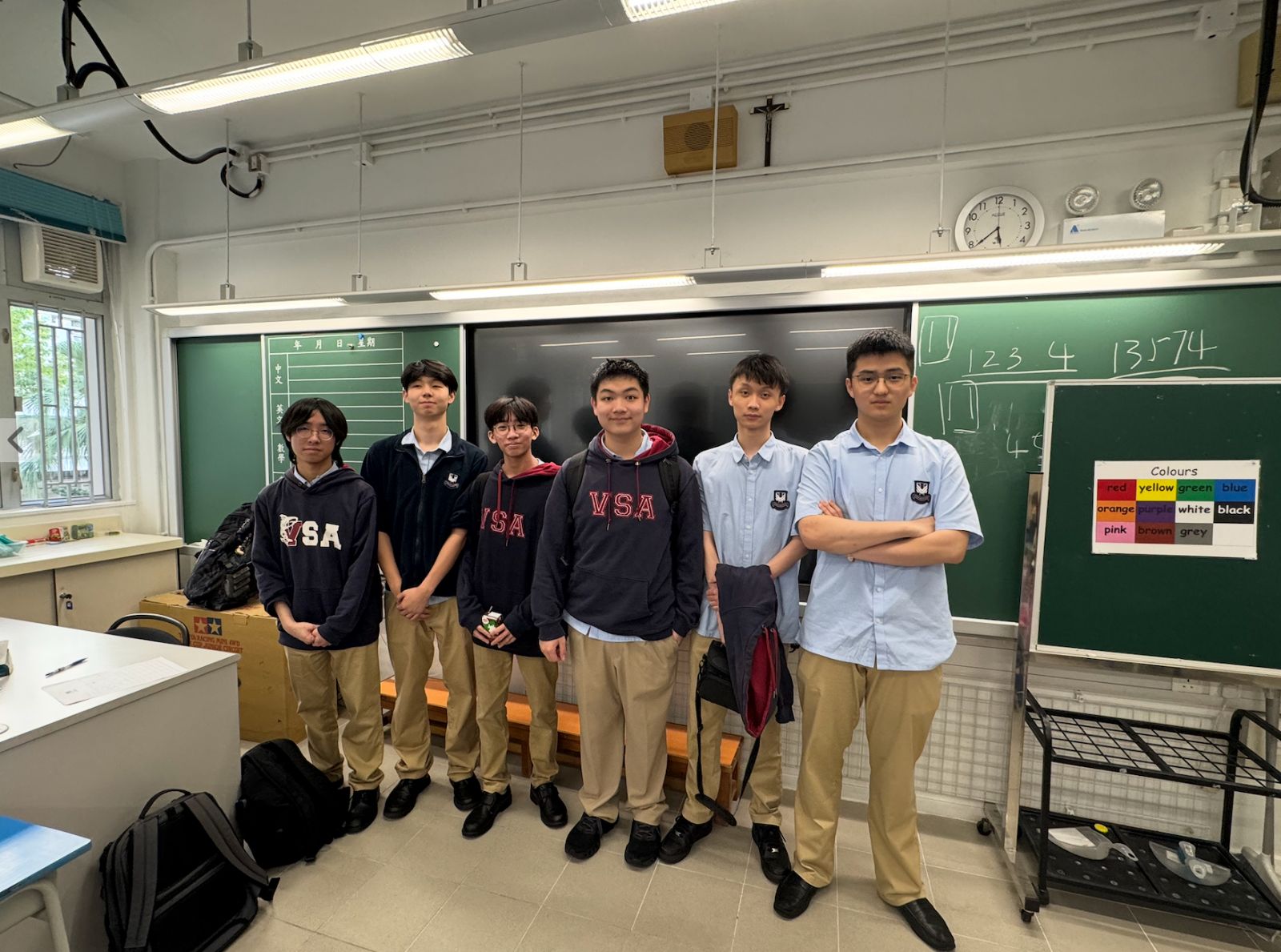
Team
Run entirely by students
More than 35 of us work on policy research and tutoring. These are the people who lead the work. Press a name to read more about them.
Justin Lo
Founder & President
Justin believes economics is one of the most powerful tools we have for changing lives, if someone is willing to carry it out of the classroom and into the places where decisions are made. That belief led him to found AI For Good in June 2023. He started with a simple question: what if students didn’t wait to be old enough to shape policy, and started now? From that question grew a student-led think tank that puts recommendations in front of the Hong Kong government every year, and a tutoring programme that brings education to children who are too often overlooked.
Justin’s focus is developmental and financial economics: why some communities are left behind, and what it takes to help them rise. He is drawn to the questions that sit between a line in a budget and a family’s everyday life: who pays for a policy, who benefits from it, and who is never asked. Leading AFG has taught him that the answer rarely lies in the data alone. It lies in carrying that data to the people who can act on it, and in listening to the people it describes.
He wants to become an economist and policymaker whose research turns into action, and whose evidence reaches people’s lives, not just journals. He isn’t aiming to understand the world from a distance. He wants to leave it measurably better than he found it, first in Hong Kong and then wherever the same gaps appear, and AFG is where he has begun.
Ka Hei Ng
Co-founder & Vice President
Ka Hei co-founded AI For Good because he believes knowledge is most valuable when it is made understandable and useful to others. He could see how quickly AI was arriving in classrooms, and how easily it could become one more thing some students grow up fluent in while others learn to find it distant or intimidating. Helping build AFG was his way of making sure that gap did not widen on his watch.
As Vice President, Ka Hei helps shape AI For Good’s direction by turning ideas into projects that students can carry out and communities can benefit from. In particular, he is interested in helping younger students engage with AI confidently and responsibly, rather than seeing it as something distant or difficult to understand. For him, a project succeeds when a child leaves the room able to use what they have learned, not just remember it.
This belief also connects with Ka Hei’s wider interest in healthcare and rehabilitation, where communication and practical application are just as important as scientific knowledge itself. A treatment helps no one if the patient cannot understand it, and a technology changes nothing if people are afraid to use it. He hopes to pursue a future where science, technology and human-centred care come together to improve people’s lives in meaningful and accessible ways, and to help build a world where recovery, like learning, is within everyone’s reach.
Oscar Zheng
Co-founder, Policy Research
Oscar co-founded AFG because he refused to accept that caring about a problem and solving it should be two different things. Drawing on the social sciences and economics, he studies the forces that hold people back. He believes advocacy is how young people can move those forces, and that one well-researched voice, raised at the right moment, can shift a decision affecting thousands.
The problems that interest him most are the ones that look permanent: unequal access to education, opportunity that follows family income, and communities that fall behind and stay there. His study of the social sciences has convinced him that none of these is a law of nature. Each is the result of choices, and choices can be questioned, argued over and changed by anyone willing to do the work.
On AFG’s research team, Oscar turns that conviction into proposals built on evidence and aimed at impact. He sees AFG as proof that students don’t need permission to start changing the world. They need the courage to begin and the rigour to be taken seriously. His ambition is to spend his life on the side of the argument that widens opportunity, and to show a generation of young people that their voices belong in the rooms where the future is decided.
David Dong
Quantitative STEM Specialist Researcher
David lives in the world of mathematics and physics, but he knows numbers alone don’t change minds. As he puts it, “the most powerful weapon is the mastery of language.” Science reveals what is true; language persuades the world to act on it. David believes that bringing the two together is how the next generation will solve problems that once seemed impossible.
As AFG’s Technical lead, David brings quantitative rigour to the team’s research and builds the tools and platforms that carry its ideas further. In practice, that means testing whether the numbers in a proposal hold up, whether the reasoning behind them is sound, and whether the case they make would survive a sceptical reader.
His aim is to make sure that when AFG speaks, it speaks with evidence, and that the evidence reaches the people it can help. Beyond AFG, he hopes to work where science meets society: using mathematics and physics to take on the hardest problems facing the world, and language to make sure the solutions are understood, trusted and put to use. He believes the breakthroughs that change the world will come from people who can both find the answer and explain why it matters.
Jackie Xue
Social Sciences Researcher
Jackie is driven by the belief that the people closest to a problem deserve a voice in solving it. Through the social sciences, he studies how policy shapes everyday lives. Through advocacy, he works to make sure those lives shape policy in return.
At AFG, Jackie researches issues, speaks with stakeholders and helps draft proposals that weigh every side before making the case for change. He believes the strongest proposals begin with listening: to the families a policy affects, the teachers who carry it out, and the people who disagree with it. Only once every side has been heard, he argues, can a recommendation claim to speak for anyone.
He sees advocacy as a form of power that anyone can claim, and he intends to use his to make his community fairer and more hopeful. In the long run, he hopes to help build public institutions that listen before they act, so that the people closest to a problem are never again the last to be asked how to solve it. For Jackie, changing the world starts with making sure everyone in it has a say.